
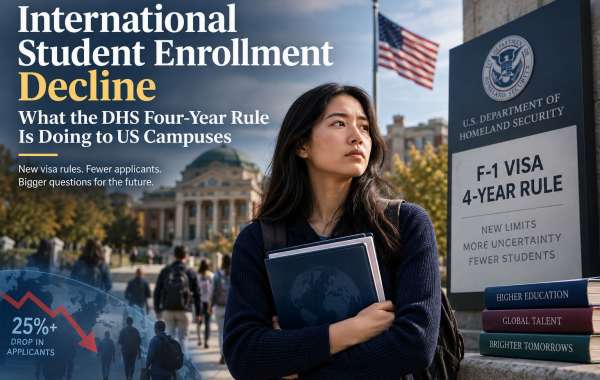
International students do more than fill university classrooms. At many US institutions, they contribute tuition revenue, work in research laboratories, support teaching sections and bring global talent into academic departments.
That makes the recent decline in international enrollment more than an admissions story.
Research examining university testimony around the new Department of Homeland Security framework found evidence of significant disruption. International applicants to the University of Illinois's flagship campus fell by more than 25 percent, while several dozen students reportedly withdrew from the University of Maryland, Baltimore just weeks before the semester began.
The change at the center of the dispute replaces the previous "duration of status" approach for F-1 students with a fixed four-year admission period. Students whose programs extend beyond that period may need to seek an extension, creating a new source of uncertainty for both students and institutions.
For universities that have spent decades building international programs, the timing could not be more significant.
International Enrollment Is Tied to More Than Tuition
The first effect of fewer international students is visible in enrollment figures, but the financial impact can spread much further.
International graduate students often pay full tuition rather than receiving subsidized in-state rates. A sudden fall in enrollment can therefore change departmental revenue projections and force universities to reconsider hiring, course planning and other academic commitments.
The research also highlights another important contribution: international graduate students frequently work in laboratories and teaching sections.
That means a smaller incoming class can affect research capacity. A laboratory expecting several graduate researchers may need to adjust its project schedule if fewer students arrive. Teaching sections may also need to be reorganized when expected graduate assistants are no longer available.
These effects are easy to overlook when enrollment is treated as a single number.
Think of a university research lab preparing for a new academic year. It may have projects planned, supervisors assigned and grant-funded work scheduled around the expected arrival of students. If several students withdraw at the last minute, the missing people can create gaps across the entire plan.
The same pattern can reach beyond campus. International students spend money on housing, food, transportation, retail and other local services. A sustained reduction can therefore affect the economies of college towns as well.
Longer Degrees Face Greater Uncertainty
The new four-year framework does not affect every student in the same way.
A student enrolled in a shorter master's program may complete the degree without reaching the four-year limit. A PhD candidate has a very different situation.
Doctoral research rarely follows a perfectly fixed schedule. A project may require additional experiments, a dissertation may need further revisions, or funding changes may delay completion. The research identifies PhD programs, dual degrees and five-year professional programs such as architecture as areas facing greater exposure to the new timeline.
This creates an unusual challenge for universities competing for research students.
Academic departments may offer excellent supervisors, laboratories and funding opportunities, but prospective students also have to consider whether the immigration timeline fits the actual length of the program.
A doctoral candidate comparing offers from the United States, Canada, the UK and Australia may therefore ask questions that would once have received little attention. How long do students typically take to finish? What happens if research runs over schedule? How does the university support students who need an extension?
Those answers could influence where a student ultimately enrolls.
Students Need More Academic Planning
Universities can reduce some uncertainty through better communication, but students also have a role in managing the academic side of the equation.
The research recommends that current F-1 students compare their expected completion date with the four-year point rather than waiting until the later stages of their degree. Early contact with an international student office can help students understand the institution's developing extension guidance.
Academic workload deserves attention as well.
Students dealing with coursework, research projects, funding deadlines and immigration paperwork may have little room for unnecessary delays. Strong planning becomes especially useful when a student is working through several major assignments at the same time.
For students who need additional support with demanding coursework, coursework writing assignments help can provide subject-focused assistance while they manage their wider academic responsibilities.
That kind of support does not replace university advising or immigration guidance. It can simply help students manage their workload when several deadlines compete for attention.
Families should also plan for possible delays rather than assuming that every degree will follow the shortest published timeline. Financial planning that includes some contingency room can reduce pressure if an academic program takes longer than expected.
Universities Must Compete on Predictability
The strongest US universities have traditionally attracted international students through research reputation, faculty expertise, career opportunities and institutional prestige.
Those advantages still matter. But the research suggests that predictability is becoming part of the decision.
The reported applicant decline at Illinois and late withdrawals at Maryland show that students can respond to immigration policy before arriving on campus. The research also identifies a Wisconsin-Madison student who directly cited the newly published DHS rule as a significant factor in withdrawing.
That gives universities a clear reason to communicate early.
Admissions teams and international offices can explain typical program timelines, extension procedures and the support available to students whose studies take longer than expected. Clear information cannot remove the policy itself, but it can make the process easier for applicants to understand.
Academic support can form another part of that effort. Students handling research-heavy programs may need help with individual academic tasks, particularly when deadlines overlap. Resources such as term paper writing help can offer additional assistance with demanding written assignments while students remain responsible for their academic decisions and immigration planning.
The Global Talent Question
The research ultimately raises a question that reaches beyond individual universities: what happens if international students begin viewing the United States as a less predictable place to complete longer degrees?
International enrollment has supplied US universities with tuition revenue and graduate research talent for decades. A prolonged decline could change the economics of graduate programs, research staffing and university planning.
That does not mean US universities will suddenly lose their appeal. They remain major centers for research and advanced education. But students now have another factor to consider when comparing destinations.
For universities, the response will require more than recruitment campaigns. Clear advising, timely communication and practical support can help institutions retain confidence among prospective and current students.
The central lesson is simple: international enrollment is connected to the wider health of the university system. When students hesitate, the effects can reach classrooms, laboratories, budgets and local communities. The institutions that recognize that connection early will be better prepared for whatever comes next.