
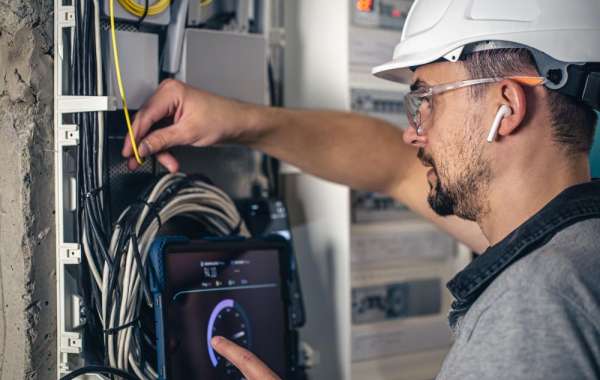
Business networks often need to move large amounts of data between network rooms, floors, buildings, or high-capacity switches. The connection between those points becomes part of the network backbone, and fiber optic cabling is frequently used to carry that traffic.
Planning fiber optic installation Las Vegas starts by identifying those connection points. From there, cable type, distance, pathways, termination hardware, network electronics, and testing all become part of the design.
Point A: Start at the Network Room
A fiber link has to connect to active network equipment somewhere.
Inside a network room, that may be a switch equipped with the appropriate optical transceiver. The transceiver converts the electrical signals used by networking equipment into optical signals that can travel through fiber.
The required network speed should be established early. So should the destination of the link and the equipment waiting at the other end.
These details influence the fiber, connectors, and optics selected for the project.
Choosing the Fiber That Leaves the Room
Single-mode and multimode are two common fiber categories used in network infrastructure.
Single-mode fiber supports optical transmission over long distances and is widely used for backbone, campus, and telecommunications applications. Multimode fiber is also used for high-speed Ethernet links, often within buildings and data-center environments where supported distances meet the network requirements.
Distance is only part of the decision.
Required Ethernet speed, compatible transceivers, existing cabling, connector types, upgrade plans, and the network hardware at both ends should be considered together.
Choosing fiber without checking the optics can result in components that don't belong on the same link.
The Journey Between Point A and Point B
Once the fiber leaves the network room, the physical route becomes the focus.
Commercial buildings may provide conduit, cable trays, riser pathways, or other telecommunications spaces. Connections between separate buildings require additional planning based on the site and installation environment.
Fiber has installation limits that need to be respected while it's being placed. Manufacturers specify requirements such as allowable pulling tension and minimum bend radius. Cable construction also needs to suit the environment where it will be installed.
Route planning should therefore happen before the cable arrives on site.
What Happens at the Other End?
An installed cable still needs to become a usable network connection.
Fiber strands may terminate in an enclosure or patch panel using connectors appropriate for the system design. Some projects involve factory-terminated assemblies, while others may require field termination or fusion splicing.
Fusion splicing joins fiber strands by precisely aligning and fusing them. The completed splice is then protected and organized within suitable hardware.
At this point, strand assignments become important. Technicians need to know which fibers correspond to each link, particularly when multi-strand cables serve several connections.
How Do You Know the Fiber Was Installed Correctly?
Testing provides measurable information about the completed link.
Optical-loss testing can verify the amount of signal loss from one end of a fiber link to the other. When required for the project, an OTDR—optical time-domain reflectometer—can provide additional information about the fiber and events occurring along the run.
Testing requirements should be established for the installation rather than decided after the cable is already in service.
Results can then be associated with the relevant link or strand, giving the business a useful baseline for future troubleshooting.
Where Does Copper Take Over?
Fiber frequently carries the backbone connection into another telecommunications room. From there, a network switch can distribute connectivity through copper Ethernet to nearby devices.
This is where structured cabling Las Vegas projects can combine different media within one network design.
A fiber backbone might connect two network closets, while Category-rated copper cabling runs from the second closet to workstations, wireless access points, VoIP phones, printers, or other Ethernet devices.
The fiber-to-copper transition happens through the network equipment, with each cabling type serving a defined part of the infrastructure.
What Should You Receive After Installation?
A completed fiber project should leave useful technical records.
Documentation may identify where each link starts and ends, fiber or cable identifiers, strand assignments, termination locations, and the results of required testing. Details about installed components may also be recorded as part of the project documentation.
This information becomes particularly valuable when another technician needs to troubleshoot a connection or network equipment is upgraded several years later.
Frequently Asked Questions
Can Fiber Optic Cable Connect Two Buildings?
Yes. Fiber is commonly used for network backbone connections between buildings. Cable construction, pathways, distance, optics, grounding considerations for associated infrastructure, and other design requirements should be evaluated for the specific site.
Should a Business Use Single-Mode or Multimode Fiber?
The appropriate choice depends on required network speed, distance, optical transceivers, existing infrastructure, and future requirements. Both fiber types support high-speed networking when used with compatible equipment and within their specifications.
Build the Backbone From End to End
Successful fiber optic installation Las Vegas begins at one piece of network equipment and finishes at another.
Everything between those points—the optics, fiber type, pathway, termination, splicing, and testing—needs to work as one link.
When that backbone eventually hands connectivity to the structured cabling Las Vegas infrastructure serving everyday network devices, the transition should already be part of the design. That's what turns an installed fiber cable into a usable piece of business network infrastructure.