
Introduction
Generative AI is moving rapidly from experimentation into everyday insurance-agency workflows. The 2026 Independent Agency Growth Study from Liberty Mutual found that 65% of insurance agents used AI for work during the previous year, up from 37% in 2025, while 41% reported using AI weekly. The study also found that agents using AI saved an average of four hours per week.
Email is one area where this efficiency can translate into more personalized outreach. Yet producing personalized copy at scale is different from producing genuinely relevant communication. This campaign study examines how generative AI could be used with an Insurance Agents Email List, what current email and insurance research says about AI-assisted personalization, and how marketers can test whether AI improves engagement without compromising data accuracy, privacy, or human oversight.
How Quickly Is AI Adoption Growing Among Insurance Agents?
The insurance industry is moving toward broader AI adoption, although implementation remains uneven.
Liberty Mutual's 2026 Independent Agency Growth Study, based on a survey of 1,149 U.S.-based independent agency principals and staff members, found that 65% of agents had used AI for work during the previous year. That compares with 37% in 2025. Weekly AI use also increased from 18% to 41%.
The research provides an important distinction between individual experimentation and organization-wide adoption:
14% of agents said their agency had already implemented an AI tool or solution.
43% said their agency was very likely to implement AI in business practices within five years.
Only 18% said their agency had a well-defined AI-use policy.
22% trusted AI technologies with business data and client information.
The data suggests that agents are adopting AI faster than many agencies are formalizing governance around it. For marketers, that means AI-generated outreach can be useful, but it should operate within clear review and data-handling processes.
What Are Insurance Agencies Using AI For?
Marketing is already one of the established AI use cases.
The 2026 Liberty Mutual study found that 18% of agents said their agency currently uses AI to generate marketing content, while 10% reported current use for marketing automation. Among agents who reported saving more than two hours per week with AI, 43% said generating marketing content was one of the activities contributing to those savings.
The future-use figures are even more significant. Forty-one percent said their agency may consider AI for marketing automation within the next two years, while 35% anticipated using AI for marketing-content generation.
This creates a practical opportunity for marketers using an Insurance Agents Mailing List. Instead of manually producing one email for every audience segment, AI can help generate variations based on verified attributes such as agency type, professional role, geographic market, or business focus.
However, the marketer remains responsible for determining whether those attributes are accurate and appropriate to use.
Does Broader Email Research Support AI Personalization?
Evidence from email marketing supports the idea that personalization is becoming a significant AI application.
A Litmus and Datalily survey conducted from December 2024 through January 2025 included 692 marketing professionals in North America and Europe. Respondents identified generative AI tools as the area having the greatest impact on their email programs at 25%, followed by personalizing email content at 18% and campaign-performance analysis at 16%.
The research is useful because it separates content generation from personalization. Generating an email with AI does not necessarily mean that the email is personalized. Personalization requires relevant information about the recipient and a reason for changing the message.
That distinction is especially important when working with an Insurance Agents Email Database. A generic AI-generated message can still be generic if the underlying audience data is not segmented.
Why Data Quality Is More Important Than AI Alone
The biggest limitation of AI personalization is often not the language model. It is the information supplied to the model.
Salesforce's 2026 State of Marketing research found that 75% of marketers had adopted AI, yet 84% said they were still running generic campaigns. The research also found that 78% of marketers needed more personalized content than they could produce, while 75% were turning to AI to help close the gap.
At the same time, 98% of marketers reported barriers to personalization, with data-related problems among the major obstacles. Salesforce found that organizations with satisfactorily unified customer data were 42% more likely to regularly respond to customers and 60% more likely to use AI agents to scale engagement.
For an insurance campaign, this means AI should not be expected to compensate for:
Outdated agency information
Incorrect job titles
Invalid email addresses
Duplicate contacts
Former agency affiliations
Missing geographic information
Poor segmentation
If an AI system receives inaccurate data, it can produce inaccurate personalization at much greater speed.
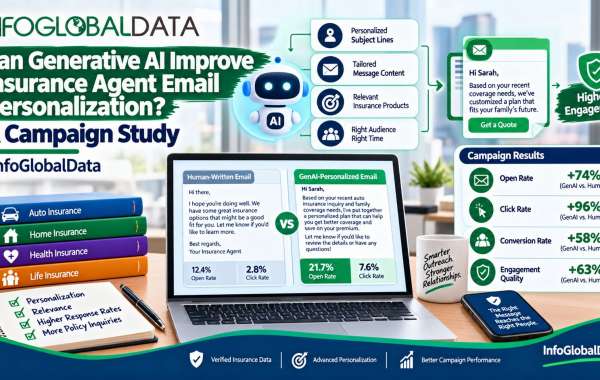
A Campaign Framework: AI vs. Conventional Personalization
A useful campaign study would compare two groups from a verified Insurance Agents Email List.
Control group
The control group receives a professionally written email containing basic personalization, such as:
First name
Agency name
General industry relevance
Standard call to action
AI-assisted group
The test group receives AI-generated or AI-assisted messaging based on verified attributes such as:
Insurance specialty
Agency type
Geographic market
Professional role
Previous engagement
Relevant business topic
The AI-generated version should then undergo human review before deployment.
For example, a generic message might promote a data solution to every insurance professional. An AI-assisted version could create separate messaging for personal-lines agents, commercial-lines specialists, agency principals, and other relevant segments.
The goal is not to make every email dramatically different. It is to make the reason for contacting each segment more relevant.
Which Metrics Should Determine Whether AI Works?
A campaign should not declare success simply because AI-generated emails receive more opens.
Instead, marketers should compare:
| Metric | What it measures |
|---|---|
| Delivery rate | Whether messages reach intended recipients |
| Bounce rate | Quality of contact data |
| Open rate | Initial attention, with privacy limitations |
| Click-through rate | Interest in the offer or content |
| Reply rate | Direct engagement |
| Qualified response rate | Relevance to the sales objective |
| Meeting/inquiry rate | Movement toward a business outcome |
| Unsubscribe rate | Audience dissatisfaction or poor targeting |
| Conversion rate | Final campaign outcome |
This approach is particularly important because email privacy technologies can make open-rate comparisons less reliable than they once were.
The Litmus/Datalily research also identified difficulty measuring or proving ROI as a leading obstacle for marketers trying to achieve their email goals.
Therefore, an AI personalization test should measure downstream actions rather than relying on a single engagement metric.
What Does Insurance Industry AI Research Say About Personalization?
The movement toward customer-facing AI is not limited to agencies.
EY's 2025 GenAI in Insurance research reported that insurers expected average cost savings of more than 20% over the following two years from AI-related productivity improvements. The research also identified enhanced marketing, personalization, and customized services among the leading front-office GenAI use cases.
The European Insurance and Occupational Pensions Authority (EIOPA) reported in 2026 that 65% of surveyed insurers had implemented GenAI, with another 23% planning adoption within three years. However, customer-facing applications accounted for only 36% of identified use cases, compared with 64% related to internal productivity, operations, and decision support.
This distinction matters. Insurance is adopting GenAI, but much of today's use remains operational rather than purely customer-facing. Email personalization is therefore part of a broader transition toward more individualized insurance communication.
Why Human Review Still Matters in Insurance Outreach
Insurance marketing operates in a more sensitive environment than many ordinary B2B campaigns.
The National Association of Insurance Commissioners (NAIC) states that AI is being used across insurance operations, including marketing, customer service, underwriting, pricing, claims, and fraud detection. Its guidance emphasizes that AI-supported decisions and actions must comply with applicable insurance laws and regulations.
NAIC also notes that regulators are examining how insurers use third-party data and AI models, including the sources of data used as inputs and the governance surrounding those systems.
For email personalization, the practical implication is straightforward: AI should assist marketers rather than operate as an unchecked source of claims.
Human review should verify:
Factual statements about the recipient.
Product or service claims.
Any insurance-related terminology.
Regulatory or compliance-sensitive language.
Personalization based on customer or prospect data.
The overall tone and relevance of the message.
5 Practical Takeaways for AI-Personalized Insurance Outreach
1. Begin with verified data
AI cannot create reliable personalization from unreliable records. Clean email addresses, agency information, professional roles, and segmentation fields before launching the campaign.
2. Segment before generating copy
Divide the Insurance Agents Email List into logical groups before asking AI to generate content. Role, specialty, geography, agency size, and engagement history can all provide useful segmentation signals when legitimately available.
3. Give AI structured inputs
Instead of asking an AI tool to “personalize this email,” provide verified context and explicit boundaries. This reduces the risk of fabricated facts and irrelevant personalization.
4. Keep a human approval step
AI can generate variations quickly, but marketers should review every campaign for accuracy, tone, compliance, and relevance before deployment.
5. Run controlled experiments
Compare AI-assisted messages against a conventional control group. Keep the offer, audience quality, sending conditions, and primary objective consistent so differences in performance can be interpreted more confidently.
How InfoGlobalData Can Support the Data Foundation
Generative AI addresses the content and workflow side of personalization, but marketers still need reliable prospect information to decide who should receive which message.
For teams building targeted insurance campaigns, InfoGlobalData can serve as a data resource for audience segmentation and prospecting. A well-structured Insurance Agents Email Database can provide the foundation for identifying relevant contacts and organizing them into campaign segments before AI is applied to messaging.
The strongest workflow is therefore not simply “AI + email list.”
It is:
Verified data → segmentation → AI-assisted content → human review → controlled campaign → performance analysis.
That structure gives AI a defined role while preserving the importance of data quality and marketer judgment.
Conclusion
Generative AI has reached a meaningful adoption point within insurance agencies. Liberty Mutual's 2026 research found that 65% of agents had used AI for work during the previous year, up from 37% in 2025, while AI-using agents saved an average of four hours per week. Marketing content was already one of the leading agency use cases.
Broader email research also indicates that personalization is becoming one of the important applications of AI, while Salesforce's 2026 research shows that data quality remains a major obstacle to personalization at scale.
The evidence therefore supports testing generative AI in insurance-agent outreach, but not assuming that AI automatically improves results. Marketers using an Insurance Agents Mailing List should combine accurate data, meaningful segmentation, AI-assisted content creation, human review, and controlled A/B testing. As AI adoption expands, the advantage is likely to come less from simply using AI and more from giving it reliable context to work with.
Frequently Asked Questions
Can generative AI personalize emails for insurance agents?
Yes. Generative AI can create different email variations using verified information such as professional role, insurance specialty, geographic market, agency characteristics, and prior engagement. However, the personalization should be based on accurate data and reviewed before sending.
What percentage of insurance agents use AI in 2026?
Liberty Mutual's 2026 Independent Agency Growth Study found that 65% of agents had used AI for work during the previous year, compared with 37% in 2025. The study surveyed 1,149 U.S.-based independent agency principals and staff members.
How are insurance agencies using AI for marketing?
The 2026 Liberty Mutual study found that 18% of agents said their agency currently uses AI to generate marketing content, while 10% reported AI use for marketing automation. Among agents saving more than two hours per week through AI, generating marketing content was reported by 43%.
Can AI-generated emails increase response rates?
AI can make personalization and message variation more scalable, but current research does not establish a universal response-rate increase for insurance-agent email campaigns. The appropriate method is to compare AI-assisted messaging against a control group using consistent campaign conditions and meaningful downstream metrics.
What information should an Insurance Agents Email Database contain?
Depending on the campaign, useful fields can include verified email addresses, contact names, agency information, professional roles, geographic market, insurance specialty, and other legitimately sourced segmentation attributes. Data should be maintained and reviewed because inaccurate records can undermine AI-generated personalization.
Why is data quality important for AI email personalization?
AI relies on the information supplied to it. Salesforce's 2026 marketing research found that data issues are among the major barriers to personalization, even though 75% of marketers reported turning to AI to help scale personalized content.
Should marketers let AI send insurance emails without human review?
Human review remains advisable, particularly for insurance-related communications. NAIC guidance emphasizes governance and compliance when AI is used in insurance, including marketing and other customer-facing activities.
What metrics should be tracked in an AI-personalized insurance email campaign?
Marketers should track delivery and bounce rates, clicks, replies, qualified responses, inquiries or meetings, conversions, and unsubscribes. Open rates can provide directional information but should not be treated as the sole indicator of campaign effectiveness.